(1 pt) Find all values of \(k\) such that \(\vec u\) and \(\vec v\) are orthogonal.
Homework 4: Projections, Span, and Linear Independence
due Sunday, October 4th, 2026 at 11:59PM Ann Arbor Time (no slip days allowed!)
Write your solutions to the following problems either by writing them on a piece of paper or on a tablet and scanning your answers as a PDF. Note that you are not allowed to use LaTeX, Google Docs, or any other digital document creation software to type your answers. Homeworks are due to Pensive by 11:59PM on the due date.
For Homework 4, you cannot use slip days; this is so that we can release solutions on Monday morning, giving you enough time to review them before Midterm 1 on Tuesday 10/6.
Homework will be evaluated not only on the correctness of your answers, but on your ability to present your ideas clearly and logically. You should always explain and justify your conclusions, using sound reasoning. Your goal should be to convince the reader of your assertions. If a question does not require explanation, it will be explicitly stated.
Before proceeding, make sure you’re familiar with the collaboration policy.
Problems
- Problem 1: Homework 3 Solutions Review
- Problem 2: Warmup
- Problem 3: Projections
- Problem 4: A Change of Reflection
- Problem 5: Lines and Planes
- Problem 6: Rows and Columns
- Problem 7: Linear Independence of New Vectors
- Problem 8: Intersections of Subspaces
Total Points: 6 + 8 + 5 + 10 + 11 + 16 + 8 + 6 = 70
Problem 1: Homework 3 Solutions Review (6 pts)
Review the solutions to Homework 3. Pick two problem parts (for example, Problem 4a and Problem 5b) from Homework 3 in which your solutions have the most room for improvement, i.e., where they have unsound reasoning, could be significantly more efficient or clearer, etc. Include a screenshot of your solution to each problem part, and in a few sentences, explain what was deficient and how it could be fixed.
Alternatively, if you think one of your solutions is significantly better than the posted one, copy it here and explain why you think it is better. If you didn’t do Homework 3, choose two problem parts from it that look challenging to you, and in a few sentences, explain the key ideas behind their solutions in your own words.
Problem 2: Warmup (8 pts)
Let \(\vec u = \begin{bmatrix} k \\ 3 \end{bmatrix}\) and \(\vec v = \begin{bmatrix} 2 \\ -1 \end{bmatrix}\), where \(k \in \mathbb{R}\) is some constant.
a)
b)
(2 pts) Find all values of \(k\) such that the projection of \(\vec u\) onto \(\vec v\) is \(\begin{bmatrix} 14 \\ -7 \end{bmatrix}\).
c)
(2 pts) Find all values of \(k\) such that \(\text{span}(\lbrace\vec u, \vec v\rbrace) = \mathbb{R}^2\).
d)
(3 pts) Find all values of \(k\) such that \(\text{span}(\lbrace\vec u, \vec v\rbrace)\) is a line in \(\mathbb{R}^2\). Then, write the equation of that line, in both slope-intercept form (\(y = mx + b\)) and parametric form. (The parametric form of a line is introduced in Chapter 4.4. There are infinitely many possible answers; give just one.)
Problem 3: Projections (5 pts)
Suppose \(\vec u, \vec v \in \mathbb{R}^n\). Let \(\vec p\) be the projection of \(\vec u\) onto \(\vec v\), and let \(\vec e = \vec u - \vec p\).
a)
(1 pt) Which of the following vectors is \(\vec e\) orthogonal to, and why? Select all that apply.
$$ \vec u, \quad \vec v, \quad \vec p $$
(You don’t need to rederive any results from Chapter 3.4, but we do want to hear your reasoning.)
b)
(2 pts) \(\text{span}(\lbrace\vec u, \vec v\rbrace)\) is the set of all possible linear combinations of \(\vec u\) and \(\vec v\). Similarly, \(\text{span}(\lbrace\vec e, \vec v\rbrace)\) is the set of all possible linear combinations of \(\vec e\) and \(\vec v\).
Let’s prove that \(\text{span}(\lbrace\vec e, \vec v\rbrace) = \text{span}(\lbrace\vec u, \vec v\rbrace)\), meaning that every vector you can create with \(\vec u\) and \(\vec v\) can also be created with \(\vec e\) and \(\vec v\), and vice versa.
Remember that the span of a set of vectors is a set too. To show that two sets \(A\) and \(B\) are equal, we need to show that every element of \(A\) is in \(B\), and every element of \(B\) is in \(A\).
Here, we’ll show that
if \(\vec x \in \text{span}(\lbrace\vec u, \vec v\rbrace)\), then \(\vec x \in \text{span}(\lbrace\vec e, \vec v\rbrace)\),
if \(\vec x \in \text{span}(\lbrace\vec e, \vec v\rbrace)\), then \(\vec x \in \text{span}(\lbrace\vec u, \vec v\rbrace)\).
We’ll do (i) for you. If \(\vec x \in \text{span}(\lbrace\vec u, \vec v\rbrace)\), then
$$ \vec x = a \vec u + b \vec v $$
for some scalars \(a\) and \(b\). But, we know that \(\vec e = \vec u - \vec p\), meaning that \(\vec u = \vec e + \vec p\). This gives
$$ \vec x = a (\vec e + \vec p) + b \vec v = a \vec e + a \vec p + b \vec v $$
But, \(\vec p\) — the projection of \(\vec u\) onto \(\vec v\) — is a vector in the direction of \(\vec v\), meaning that \(\vec p = c \vec v\) for some scalar \(c\). (Chapter 3.4 has the optimal value of \(c\) but it’s not important in this proof.) Substituting \(\vec p = c \vec v\) gives us
$$ \vec x = a \vec e + a \vec p + b \vec v = a \vec e + a (c \vec v) + b \vec v = a \vec e + (ac + b) \vec v $$
This last expression, \(a \vec e + (ac + b) \vec v\), is a linear combination of \(\vec e\) and \(\vec v\), meaning that \(\vec x \in \text{span}(\lbrace\vec e, \vec v\rbrace)\), as required.
Your turn: complete (ii) by showing that if \(\vec x \in \text{span}(\lbrace\vec e, \vec v\rbrace)\), then \(\vec x \in \text{span}(\lbrace\vec u, \vec v\rbrace)\).
c)
(2 pts) To recap, the point of the previous part was to show that any vector that can be created with \(\vec u\) and \(\vec v\) can also be created with \(\vec e\) and \(\vec v\).
Using what you learned in Chapter 3.4 (and Lab 4), explain why we’d rather write some new vector \(\vec b\) as a linear combination of \(\vec e\) and \(\vec v\), rather than \(\vec u\) and \(\vec v\).
Problem 4: A Change of Reflection (10 pts)
In this problem, we will explore the idea of reflecting a vector across a line. This problem has applications to computer graphics, where reflecting vectors across a line can produce a mirror image of a two-dimensional shape.
The picture below shows reflection of the vector \(\vec u = \begin{bmatrix} 7 \\ -3 \end{bmatrix}\) across the line spanned by \(\vec v=\begin{bmatrix}1\\1\end{bmatrix}\).
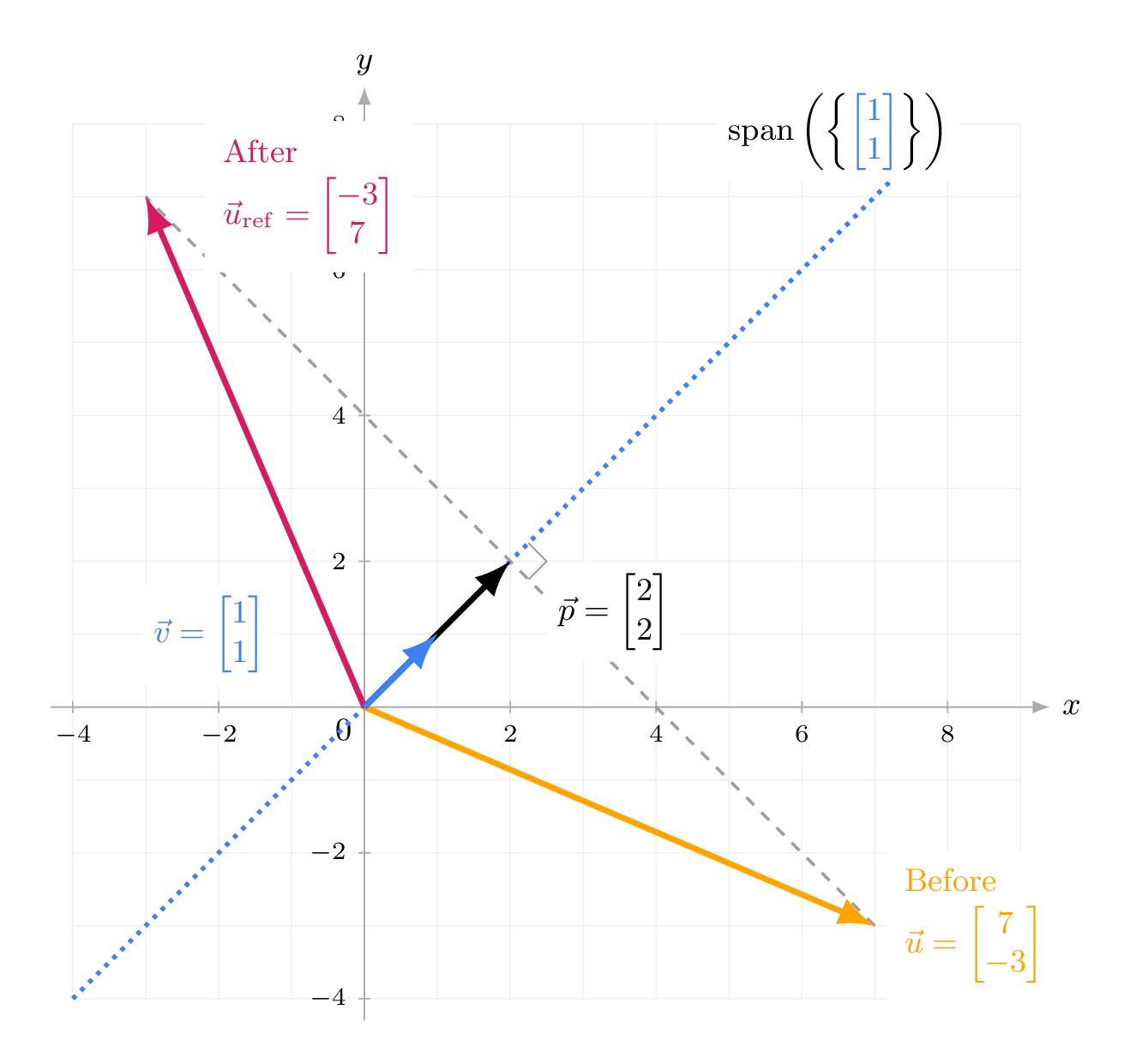
In the picture above, reflecting \(\vec{u}=\begin{bmatrix}7\\-3\end{bmatrix}\) across the line spanned by \(\vec v\) gives us \(\vec{u}_{\mathrm{ref}}=\begin{bmatrix}-3\\7\end{bmatrix}\). Notice that \(\vec{p}=\begin{bmatrix}2\\2\end{bmatrix}\), the projection of \(\vec{u}\) onto \(\vec v\), has its tip halfway between the tips of \(\vec u\) and \(\vec u_\text{ref}\). To get from \(\vec{u}\) to \(\vec{u}_{\mathrm{ref}}\), we move to \(\vec{p}\), then keep going the same distance in the same direction.
a)
(4 pts) Let \(\vec u=\begin{bmatrix}4\\3\end{bmatrix}\) and \(\vec v=\begin{bmatrix}1\\2\end{bmatrix}\).
Find the projection \(\vec p\) of \(\vec u\) onto \(\vec v\).
Now, find \(\vec u_\text{ref}\), the reflection of \(\vec u\) across the line spanned by \(\vec v\).
Draw a picture showing \(\vec v\), the line spanned by \(\vec v\) (dotted, as in our example), \(\vec p\), \(\vec u\), and \(\vec u_\text{ref}\).
b)
(2 pts) Find the reflection \(\vec u_\text{ref}\) of \(\vec{u}=\begin{bmatrix}3\\-1\\2\end{bmatrix}\) across the line spanned by \(\vec v=\begin{bmatrix}1\\1\\2\end{bmatrix}\). You don’t need to draw a picture.
c)
(4 pts) Let \(\vec{u},\vec{v}\in\mathbb{R}^n\) be nonzero vectors. Find a formula for the reflection \(\vec{u}_{\mathrm{ref}}\) of \(\vec{u}\) across the line spanned by \(\vec v\). Your answer should be an expression that involves \(\vec u\), \(\vec v\), and/or constants.
Problem 5: Lines and Planes (11 pts)
As we saw in Chapter 4.1, the span of two linearly independent vectors in \(\mathbb{R}^n\) is a 2-dimensional subspace of \(\mathbb{R}^n\), which we call a plane when working with vectors from \(\mathbb{R}^3\). In this problem, we will build your understanding of lines and planes in \(\mathbb{R}^3\).
To help you visualize lines and planes, consult:
(Primary) The supplemental Jupyter Notebook we’ve created for Homework 4, which can either be found here on DataHub, or here in the course GitHub repository.
Chapter 4.4 of the course notes, which focuses on this idea.
The solutions to Lab 4, Activity 6.
Desmos’ 3D mode: desmos.com/3d.
a)
(3 pts) Consider the plane \(7x - 3y + 4z = 0\). This is a plane written in standard form,
$$ ax + by + cz + d = 0 $$
Find two vectors that lie in this plane, and use those vectors to write the plane in parametric form. (There are infinitely many possible answers, since the parametric form of a line, or plane, or subspace in general is not unique.)
b)
(8 pts) Consider the linearly independent vectors
$$ \vec v_1 = \begin{bmatrix} 7 \\\\ -1 \\\\ 2 \end{bmatrix}, \quad \vec v_2 = \begin{bmatrix} 2 \\\\ 1 \\\\ 1 \end{bmatrix}, \quad \vec v_3 = \begin{bmatrix} 3 \\\\ 1 \\\\ 1 \end{bmatrix} $$
In standard form, find the equation of the plane spanned by \(\vec v_1\) and \(\vec v_2\).
Hint: Use the cross product from Chapter 4.4 to find the values of \(a\), \(b\), and \(c\) in \(ax + by + cz + d = 0\), and you know what \(d\) must be by the definition of the span of a set of vectors.
In standard form, find the equation of the plane spanned by \(\vec v_1\) and \(\vec v_3\).
Your answer should be a different plane than the one you found in subpart (i). (This is an important point: since \(\vec v_1, \vec v_2, \vec v_3\) are linearly independent, any pair of them span a plane, but all three pairs of them span different planes.)
The planes you find in subparts (i) and (ii) intersect at a line. Solve for the equation of this line of intersection in parametric form. What do you notice about the equation of the line?
To help you visualize this line of intersection, use the supplemental Jupyter Notebook.
In standard form, find the equation of the plane spanned by \(\vec v_2\) and \(\vec v_3\). Now, find the intersection of this plane with the object from subpart (iii). What type of geometric object is this new intersection?
Once again, use the supplemental Jupyter Notebook to visualize this intersection.
Problem 6: Rows and Columns (16 pts)
Soon, we will start to learn about matrices. In this problem, we’ll start to connect what we’ve learned about vectors and spans to matrices. In this question, we’ll consider the matrix \(A\):
$$ A = \begin{bmatrix} 5 & 3 & 5 & 2 \\\\ 3 & 0 & -6 & 4 \\\\ -2 & 0 & 4 & 3 \\\\ 8 & 2 & -6 & -8 \\\\ 1 & 1 & 3 & 0 \end{bmatrix} $$
\(A\) has 5 rows and 4 columns. There are two ways of looking at \(A\):
As a collection of 4 “column” vectors, each in \(\mathbb{R}^5\), stacked side-by-side.
As a collection of 5 “row” vectors, each in \(\mathbb{R}^4\), stacked on top of each other.
a)
(4 pts) Using the algorithm in Chapter 4.2, find a linearly independent set of vectors in \(\mathbb{R}^5\) with the same span as the column vectors of \(A\). How many vectors are in this set?
b)
(5 pts) Find a linearly independent set of vectors in \(\mathbb{R}^4\) with the same span as the row vectors of \(A\). How many vectors are in this set?
You should have found that the number of vectors you found in both parts is the same. This is not a coincidence, it is true for any matrix — the number of linearly independent columns is the same as the number of linearly independent rows. This number is called the rank of the matrix.
If you were to run the following Python code, the number you’d see back is the number of linearly independent vectors you found in both parts.
import numpy as np

A = np.array([[5, 3, 5, 2],
              [3, 0, -6, 4],
              [-2, 0, 4, 3],
              [8, 2, -6, -8],
              [1, 1, 3, 0]])

np.linalg.matrix_rank(A)
c)
(5 pts) Open the the supplemental Jupyter Notebook we’ve created for Homework 4, which can either be found here on DataHub, or here in the course GitHub repository.
Complete the three tasks within orange lines, related to the introduction we’ve provided above. Include screenshots of your code and its output as part of your PDF.
d)
(2 pts) Using what you observed in the notebook, by hand (that is, without using Python), compute the result of the following matrix-vector multiplication:
$$ \begin{bmatrix} 2 & 4 & 5 \\\\ 3 & 9 & 8 \\\\ 4 & 0 & 1 \end{bmatrix} \begin{bmatrix} 4 \\\\ 1 \\\\ 3 \end{bmatrix} $$
Problem 7: Linear Independence of New Vectors (8 pts)
Suppose \(\vec v_1, \vec v_2, \vec v_3 \in \mathbb{R}^n\) are linearly independent. In both parts below, determine if the new set of vectors is linearly independent. If they are, prove that they are by showing that the only solution to the equation
$$ a \vec u_1 + b \vec u_2 + c \vec u_3 = \vec 0 $$
is \(a = b = c = 0\). If they are not, show that there exist scalars \(a, b, c\) such that \(a \vec u_1 + b \vec u_2 + c \vec u_3 = \vec 0\) where at least one of \(a, b, c\) is non-zero.
a)
(4 pts) \(\vec u_1 = \vec v_2 - \vec v_3\), \(\vec u_2 = \vec v_1 - \vec v_3\), and \(\vec u_3 = \vec v_1 - \vec v_2\)
b)
(4 pts) \(\vec u_1 = \vec v_2 + \vec v_3\), \(\vec u_2 = \vec v_1 + \vec v_3\), and \(\vec u_3 = \vec v_1 + \vec v_2\)
Problem 8: Intersections of Subspaces (6 pts)
Let:
\(M\) be the subspace of \(\mathbb{R}^4\) spanned by \(\begin{bmatrix}1 \\ 1 \\ 1 \\ 0\end{bmatrix}\) and \(\begin{bmatrix}0 \\ -4 \\ 1 \\ 5\end{bmatrix}\).
\(N\) be the subspace of \(\mathbb{R}^4\) spanned by \(\begin{bmatrix}0 \\ -2 \\ 1 \\ 2\end{bmatrix}\) and \(\begin{bmatrix}1 \\ -1 \\ 1 \\ 3\end{bmatrix}\).
a)
(2 pts) Find a vector that belongs to both \(M\) and \(N\). In other words, find a vector \(\vec v\) such that \(\vec v \in M\) and \(\vec v \in N\). There are infinitely many answers; state the answer with a first component of 1.
b)
(4 pts) Find the dimension of the set of all vectors that belong to both \(M\) and \(N\). Explain your reasoning.